
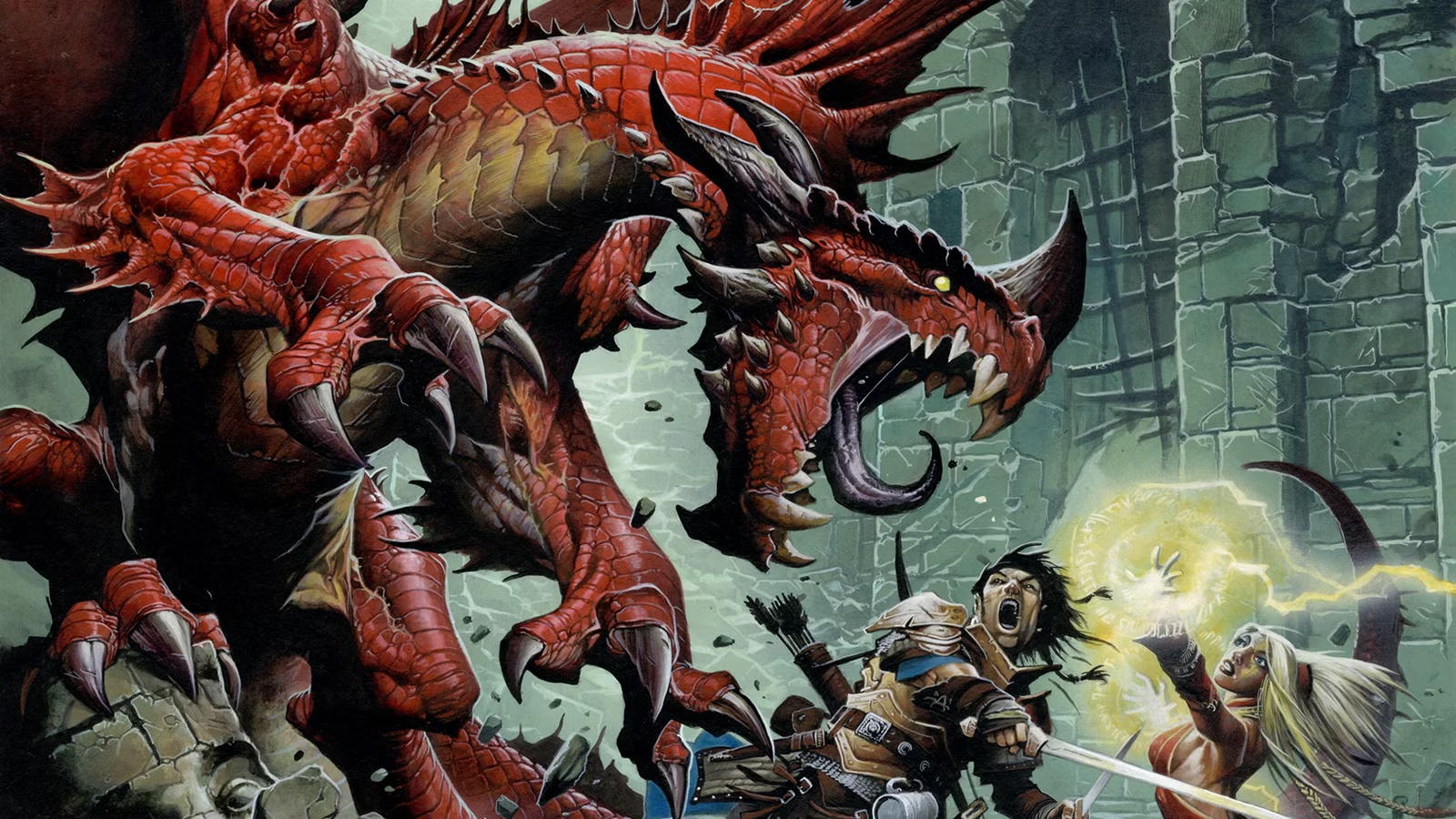
Dungeons & Dragons and Pathfinder are some of the most popular tabletop RPGs out there and rightfully so – both offer players the chance to embark on epic adventures, battle horrifying monsters, and explore amazing worlds full of magic and wonder. And while there are so many similarities between the two in terms of design, there are also a few key differences that set them apart and make them unique.
In this blog post, we’ll go through the main differences between DnD 5e and Pathfinder 2e so you can make an informed decision on which game is the right fit for you. Also, we’ll focus on the gameplay mechanics, rather than the setting. So let the DnD vs Pathfinder showoff commence!
9. To Multiclass or Not to
If you want to multiclass in Pathfinder 2e, anytime you get a class feat, you can choose the multiclass Dedication feat which will give you some skill and features of a second class. Next time you get a class feat, you can pick one from the new class you chose. This essentially means that you never stop leveling up in your original class, and never actually leave it either – you just get a limited number of abilities of different classes.
8. There is no Advantage or Disadvantage in Pathfinder
In Pathfinder when making a roll, you need to add up all the circumstantial bonuses and penalties to figure out your final/net modifier. So the favorable occurrences around you will give you a bonus, and the unfavorable ones will subtract from the total. This is way more complicated and math-heavy than the Advantage/Disadvantage system of 5e where you roll twice and choose the bigger or smaller number respectively, based on your current circumstances.
7. A Potentially Better Proficiency Bonus
The proficiency system in DnD is binary – a character is either proficient in a skill, or they are not, there is no in-between. The proficiency bonus also depends on a character’s level and caps off at +6.
In Pathfinder, you have five different levels of skill aptitude – untrained, trained, expert, master, and legendary – and each of them comes with their own proficiency bonus which ranges from +0 to +8.
6. The Differences in Backgrounds
When it comes to choosing your character background, you’ll find great options that bring you extra skills and proficiencies in both games. A bigger variety is offered in Pathfinder 2e, but bigger isn’t necessarily better in this case. In DnD 5e, players can also choose a personality trait, flaw, and bond. These can help players get a better feel for their characters and give them guidelines for their role-playing.

5. Failing to Prepare Means Preparing to Fail – Prepared Casters Explained
Essentially, there are two types of casters in DnD and Pathfinder – the Prepared (Cleric, Druid, or Wizard) and Spontaneous (Bard, Sorcerer). Prepared casters have access to their entire spell lists, but need to choose which ones they want to use and prep them in advance. In DnD, they can then blast only one of them, or use them all – they just need to take their spell slots into account.
But in Pathfinder, if casters want to use a spell more than once, they also need to prepare it more than once too. Also, if you want to cast a spell from a higher spell slot, you also need to prepare it at a higher level too. These restrictive rules make spellcasters less powerful in Pathfinder 2e but also keep them better balanced with the martial classes.
4. Ancestry Feats for Days in Pathfinder
Both DnD and Pathfinder start off with the character creation stage where you pick the race and class you want. In DnD 5e, most of the races you pick will get you a bonus for one or two Ability scores, an additional spoken language, and Darkvision if you’re lucky. Some will also bring their own racial features, but that’s it. You get what you get and once you start playing, there are no more racial abilities coming your way.
The situation is a bit different in Pathfinder since your pick of race aka ancestry will be a gift that keeps on giving. You’ll get to pick one ancestry feat at the first level, and then an additional one every four levels.
3. Class Differences
You’ll find basically the same playable core classes in both games with small changes – Pathfinder adds the Alchemist and turns the Paladin into a Champion. Also, there’s no Warlock to be found. But, the Pathfinder team is much quicker with releasing new playable classes – like the four new ones in Advanced Player’s Guide.
The biggest class differences, as I like to call them, come into play when you consider the class features in both games. In Pathfinder, a character will learn a new skill, acquire an ability or get better at an old one at every single level so you can customize your character way more and there are no “dead levels” like in 5e.
2. The Three-Action Economy for Combat
In DnD, a character can make an action, a bonus action, a reaction if they’re lucky, and move a certain distance during their turn in combat. In Pathfinder, each character gets three actions from the start and how you use them is up to you – you can use them to attack, move, interact with an object, unsheath a blade, cast a spell, etc. Each action you make will use up a different number of the three available to you. Their exact “cost” is detailed in the Pathfinder 2e Rulebook, so be sure to check that out. This system will, in theory, allow a first-level character to attack three times from the start, but they will be affected by the multiple-attack penalty.
1. Critical Hits or Fails Improved
Many members of the RPG community will agree that one of the best differences between DnD and Pathfinder is how each game handles critical hits and fails.
In DnD, the rules are pretty simple – if you roll a 1, you instantly fail in whatever you were attempting to do, and if you roll a 20, your action is an instant success. If you rolled a 20 on an attack roll, then you are also entitled to deal additional damage aka you will double the damage roll you make.
In the Pathfinder system, besides scoring a critical success when you roll a natural 20, you can also do it when you roll a number that is higher than the opponent’s DC by 10. This additional rule stipulation may cause you to get many more critical hits than in DnD. On the other hand, the same rule applies for critical failures too – if you fail the check by 10 or more, that’s referred to as a fumble and it might bring some more negative effects to players too.
It is important to emphasize that this “beating by 10” system, doesn’t have to apply to all checks. For some unimportant ones, you can just go the ordinary success or failure route.
Which is Better – DnD or Pathfinder?
To conclude this blog post, we need to answer this very complicated question – knowing everything we know – which is better? To me, that’s like asking me: “Which came first – the chicken or the egg?” (except in this case, we knew which one came first – it was DnD)
Nevertheless, it is impossible to answer this since they cater to people who like different aspects of TTRPGs and it is ultimately going to depend on what you and your group of friends prefer. DnD is a great introduction to the wonderful world of RPGs, and since it’s basically a household name, it’s going to be easier for you to find people to play with. Also, the rules are pretty streamlined and easy to get the hang of. Pathfinder, on the other hand, offers way more customization for players and has managed to work out some gameplay mechanic kinks from 5e, but the rules are very dense, much more complicated, and don’t offer many improvisational opportunities for GMs.
So, my official answer is (even though this might be a copout) – neither is better, they’re amazing games, but for slightly different audiences!


