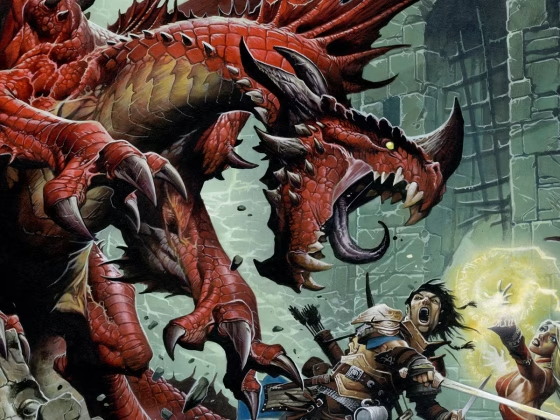
Pathfinder is a fantasy tabletop role-playing game (TTRPG) that has become a favorite of fans all around the world since its introduction in 2009 because of its flexible system for making highly customizable characters, deep lore, and intricate game mechanics. Even though it had humble beginnings, Pathfinder is now widely considered one of Dungeons & Dragons’ fiercest competitors, so it may be hard to believe that, at one point, Paizo (Pathfinder’s publisher) and Wizards of the Coast (DnD’s publisher) were actually working together.
In this post, I’ll talk about the origin of Pathfinder TTRPG, from its beginning as an alternate rule set for DnD to its current position as a game that stands on its own two feet.
Pathfinder and DnD – Friends to Foes?
A long long time ago (from 2002 to 2007) in a galaxy far far away (the US), Paizo Publishing was actually putting out two DnD magazines conveniently named Dungeon and Dragon. But, when Wizards of the Coast decided not to renew their contract in early 2007, they moved on to publishing rule supplements for the edition of DnD that was currently out – the 3.5.
So, you might be asking yourself – what made them step away from DnD and create their own game? Well, in order to properly explain that, we need to take a little step back while I tell you about the RPG boom at the beginning of the 2000s.

One License to Rule Them All
Believe it or not, the RPG community was actually thriving in the early aughts. A new DnD edition – 3e – came out which spiked the game’s popularity, Paizo, Green Ronin, Atlas Games, and Necromancer Games were publishing RPG-themed materials, everything was well and there was peace in the land.
All of this was made possible by one thing, and one thing only – the Open Game License (OGL) issued by WotC. This magical piece of paper allowed people who wanted to make their own TTRPGs using DnD game mechanics to do exactly that. If you ask me, it was a stroke of marketing genius for WotC because people put out so many of their own RPGs with the d20 system, they made DnD even more popular and boosted the core rulebook’s sales. It worked like a charm, but, unfortunately, all good things must come to an end.
When Wizards announced the arrival of 4e, they also revealed they were planning to step away from the Open Games License and transition to the new Game System License which was far more restrictive. And then, only a year and a half after 4e, Pathfinder 1e was born.
How Is Pathfinder Different From DnD?
At its core, Pathfinder was very similar to DnD – it used the d20 system and was heavily inspired by 3.5e, but the thing that made it unique is the way they approached character creation, the high fantasy Golarion setting and the little rule tweaks that changed gameplay mechanics for the better. If you want a comprehensive list of the biggest changes between Pathfinder and DnD, we have a blog post on that subject! LINK HERE
The Rise of Pathfinder TTRPG
The first edition of Pathfinder (1e) was launched in 2009 and the second one (2e) in 2019. Both editions have a core rulebook and were followed by additional supplementary materials like new classes, spells, optional game features, equipment, and even a whole Beastiary series.
Pathfinder’s “rival” aka 4e was then and is still widely considered a big step in the wrong direction for WotC and the worst edition of DnD out there. It was much too complicated, too combat-based, and had limited character customization. This dislike for 4e combined with a large part of the RPG community’s disappointment of WotC embracing a new license created the perfect base for Pathfinder to thrive. Many members of the community dubbed Pathfinder – DnD 3.75e – because it relied on the game mechanics of the beloved 3.5e.
I believe that these were some of the reasons why, in the time period between the spring of 2011 and the summer of 2014, Pathfinder sales at times surpassed those of DnD, stopping their almost forty-year run as the top-selling RPG.
With the introduction of 5e, which is widely considered the best DnD edition of all time, and WotC going back to the OGL, things went back to the status quo. In the 2020s, DnD is more popular than ever, and much more of a household name. But, even though Pathfinder doesn’t have the mainstream popularity of DnD, it still has a very large and dedicated following in the RPG community.