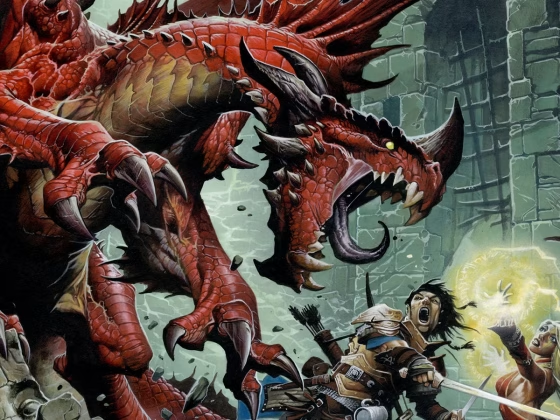
A warrior steps forward, raising a blade of humming, brilliant light to cleave through a heavy stone vault. It looks like a classic magic sword, but a closer inspection reveals the truth: the hilt is a severed metallic limb, and the blade is a vibrating plasma torch grafted to its exposed wiring. Dungeons & Dragons veterans can easily keep their love of high adventure when moving to Numenera, while quickly learning why the game’s engine pushes discovery, improvisation, and forward momentum. The Cypher System powers this experience by relying on three primary levers that fundamentally change how players make decisions: cyphers, resource pools, and GM intrusions. Whether you are planning your first campaign or looking for a practical numenera cyphers guide for running the game’s signature one-use tech, understanding these elements is essential for mastering the Ninth World.
Weird Tech Made Portable: The Cypher Economy
Cyphers represent the setting’s weird technology made portable. They are the rules’ direct answer to traditional loot, but they come with a deliberate catch: they are meant to be used immediately, never hoarded. Characters have a strict cypher limit, creating a constant, mechanical pressure to experiment.
Imagine a group exploring a ruined facility and discovering two strange devices: a palm-sized crystalline node that manipulates gravity, and a canister of viscous fluid that grants temporary telepathy. The party only has room to safely carry one more cypher. Instead of leaving treasure behind, they decide to drink the telepathy fluid right then and there to read the mind of a nearby scavenger, while pocketing the gravity crystal for later. This translates directly into dynamic table behavior. Players should expect frequent, surprising tools that encourage bold plans rather than conservative resource management.
This cycle connects directly to discovery-driven play. Each cypher acts as a question about the world. A pill that turns flesh into living steel or a metallic spider that weaves a temporary bridge of hard light feels like magic, but reads like ancient technology. Game Masters can reskin these effects freely to match local ruins, floating dataspheres, living machines, or alien biotech, ensuring that the mechanics always serve the fiction of the setting.
The Risk Calculus of Pools and Effort
Instead of a standard list of attributes, characters in Numenera rely on three Pools: Might, Speed, and Intellect. Spending from these Pools forms the core risk calculus of the game. Hit points are not just a measure of physical health; they represent stamina, focus, and capability. Every push for success has a tangible cost, which drastically changes decision-making compared to the separate resource tracks found in D&D.
Consider a concrete action like forcing a sealed plasteel door while a pack of synthetic hounds closes in. A player chooses to rely on Might and decides to apply a level of Effort, spending three points from their Might Pool to lower the difficulty of the task. They also use a heavy crowbar as an asset and decide to burn a cypher that weakens molecular bonds. The tradeoffs are felt immediately. Spending that Might guarantees the door opens, but it leaves the character physically drained and closer to death if the hounds catch up. Because the same Pools fuel offense, defense, and basic survival, combat is rarely the default solution to a problem.
Rethinking Balance and Lethality for D&D Veterans
For players accustomed to D&D, encounter expectations require a shift in perspective. Balance in Numenera is less about mathematically calibrated fights and more about readable risk, clear escape routes, and maximizing player agency. The system can be highly swingy when Pools drop low, and a bad death spiral is entirely possible if players overextend themselves without a backup plan.
The game expects negotiation, cleverness, and retreat to be treated as valid, satisfying victories. A monster is often just another hazard of the Ninth World, and surviving an encounter by tricking a beast into a localized gravity anomaly is just as rewarding as defeating it with a sword.
GM Intrusions as the Engine of Momentum
To keep the story moving, Numenera relies on GM intrusions. This mechanic serves as the momentum engine and a core part of the table’s social contract, providing a way to turn sudden complications into narrative developments while paying players Experience Points. When the GM introduces an intrusion, the targeted player can accept the complication and take two XP, or refuse it by spending one XP from their own stash.
Intrusions are not punishments. They are invitations to make the situation vastly more interesting. Picture a successful climb up a rusted orbital tether. Just as the character reaches the top, the GM triggers an intrusion: the vibrations of the climb awaken a dormant defense drone. The player accepts, taking the two XP. They keep one and immediately hand the second XP to another player at the table, rewarding the whole group for leaning into trouble. To keep intrusions feeling fair and exciting, they should be well-telegraphed, tied directly to the weirdness of the Ninth World, and paced so they escalate the tension naturally.

Prepping Discovery-First Scenarios and Sites
Practical GM prep in Numenera focuses heavily on discovery-first scenarios where the primary mystery is the setting itself. Instead of prepping rigid plots, you prep questions. Locations should be built as layered revelations. When designing a ruin, determine what it looks like on the surface, what it actually does, what its original purpose was a billion years ago, and what it wants now.
Stocking a site means filling it with interactive oddities. Include devices with unclear interfaces, environmental puzzles that defy standard physics, and local factions with competing interpretations of the ruins. Add hazards that can be studied, bypassed, or actively exploited by clever players. Exploration becomes a process of experimentation rather than simply mapping out ten-foot corridors.
The Architecture of a Numenera Session
Exploration in Numenera looks entirely different from the typical D&D loop of room-to-room combat and treasure gathering. It involves interpreting ancient artifacts, negotiating with strange, localized intelligences, managing Pools over days of travel, and using cyphers as probes to test the environment. Dungeons, wilderness travel, and set-piece fights certainly exist, but they serve the higher goal of discovery.
Running a session smoothly follows a natural rhythm. Start the evening with a hook tied directly to a numenera mystery. Quickly present an immediate oddity that invites physical interaction. Before the players get too comfortable, reveal a complication via a GM intrusion or a sudden faction move. Offer multiple paths forward, allowing the players to choose how they engage with the threat. Finally, end the session with a new question that points to the next layer of the world.
Making the adjustment to this style of play requires setting clear expectations. Players should spend their resources proactively and use their cyphers early. They must treat XP as both a path to character advancement and a vital meta-currency for rerolling dice or refusing intrusions. Furthermore, worldbuilding is collaborative; character descriptors, foci, and personal discoveries actively shape the reality of the game.
Adjudicating Difficulty and Speeding up Play
Numenera uses a straightforward level system from 1 to 10 to adjudicate difficulty. The target number for any roll is simply the level multiplied by three. Assets, appropriate skills, and applied Effort reduce the level of the task rather than adding modifiers to the die roll.
This math happens entirely on the player’s side, which drastically speeds up play. The GM never rolls dice, freeing them to focus entirely on narration, pacing, and reacting to player choices. Fast resolution leaves significantly more table time for interpretation, roleplaying, and meaningful choice, keeping the spotlight exactly where it belongs: on the characters interacting with an unpredictable world.
The Archaeology of the Impossible
The aesthetic of the Ninth World thrives on sensory details and metaphors that read like the archaeology of the impossible. Ancient technology here is functionally magic, but it carries history, purpose, and physical consequences. A healing device might not emit a warm golden glow; instead, it might be a swarm of microscopic crystalline insects that stitch wounds together with synthetic webbing, leaving a faint scent of ozone in the air.
That plasma torch grafted to a metallic arm from the opening is no longer just a cool visual. You now have the framework to understand it mechanically and narratively. Treat cyphers as disposable wonder, respect Pools as a measure of meaningful risk, use intrusions to drive forward motion, and approach session prep as a series of fascinating questions. Treat every strange device as both a solution and a clue, and let this numenera cyphers guide serve as your foundation for embracing the Ninth World’s weird tech and its momentum-driven play.